Acomb
Grange by Jennifer Kaner -
page 1
If
you have accessed this web page via the home page of Acomb Grange, it will be
visible in a frame, which may make it necessary to scroll to read it. If this
is inconvenient, it is possible to access this page directly on http://www.yorkholidays.co.uk/history.htm
and it will be displayed in a full screen.
Footnotes and references are an
essential part of any scholarly work but they can also interrupt the flow of
the text. To help the reader on this website, references to sources are shown
in the usual way with superscript numbers. Clicking on the reference number
will show the details of the reference by hyperlink, and clicking at the end of
the reference will return you to the main text at the point where you left it.
Years are highlighted thus 1409
|Goto page 2 | Home page | about the
author,Jennifer Kaner | About the publishers
Summary
This article traces the
history and ownership of Acomb Grange from the 12th century to the present day.
The article was the winner of the 1991 Sheldon Memorial Trust Essay
Competition.
|
Introduction and early history. |
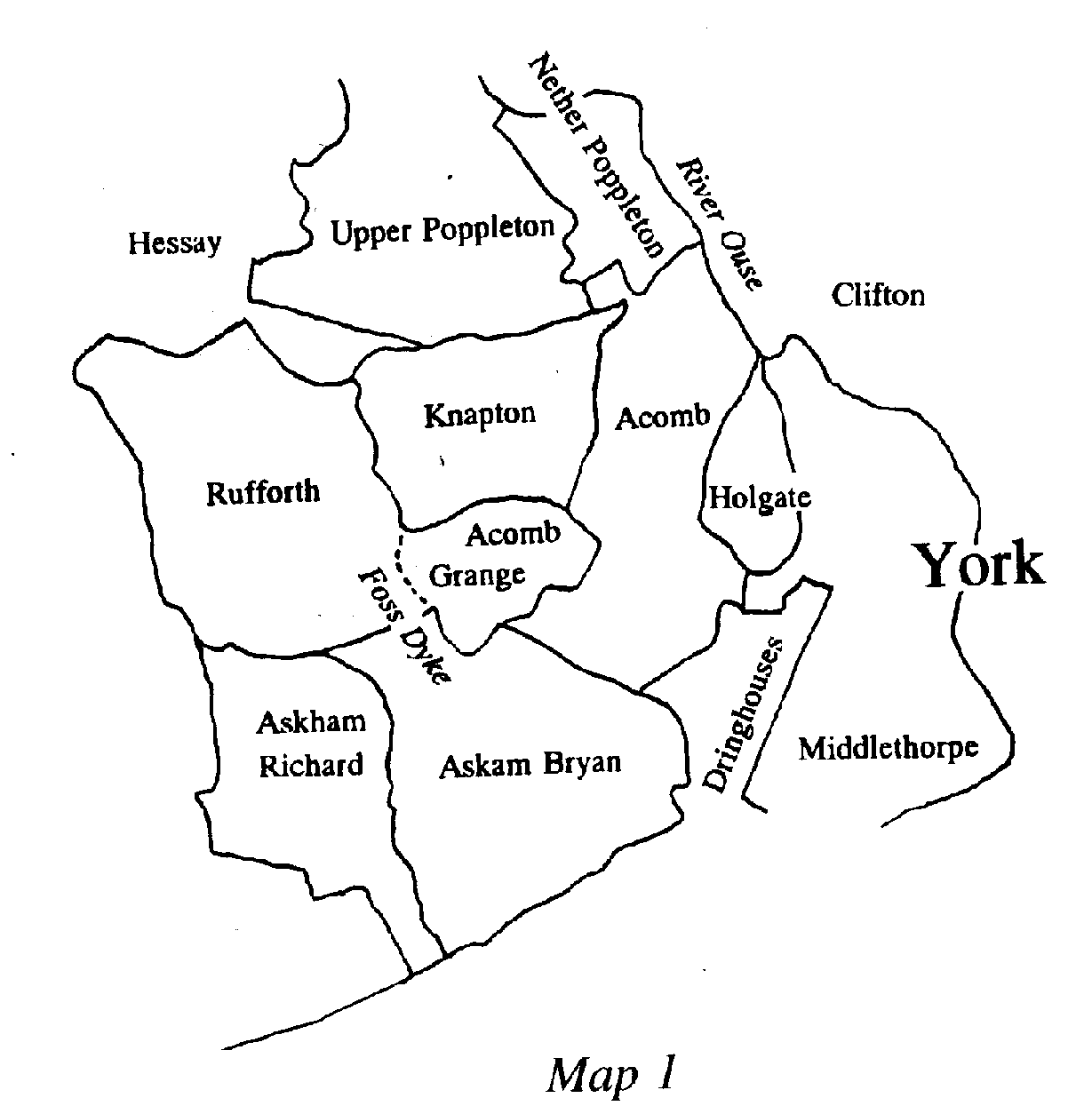
Sketch Map of the area round Acomb Grange, showing township boundaries. Based on the 0.S. map of 1852. |
|
Acomb Grange, as a distinct and separate estate since the 12th century,deserves to have its history
recorded. It lies on the immediate outskirts of modern York , in the green
belt, only 2.75 miles from York Minster, and yet it has remained an entity
for 800 years Figure 1 |
|
|
Domesday Book .In 1086, in the Domesday Book, the entry for the vill of Acomb records 16.5 carucates for geld, of which 14.5 belonged to the Archbishop of York and two belonged to the King. The Archbishop's land included wood pasture two furlongs long and two wide, while in the King's land, besides land for one plough, there were 10 furlongs of wood. Woodland plays a significant part in the history of Acomb Grange. |
|
By the end of Stephen's reign the Hospital was separated from the Minster and had received an alternative name of St. Leonard's. It acquired more land and set out to maximise returns from its properties to provide income for running the Hospital |
|
Gift of Henry I The history of the Grange as a separate entity starts when
Henry I gave two carucates of land in Acomb to the Hospital of St Peter in York
by a charter dated between 1123 and 1133.1 This gift of land in Acomb was the
first of numerous post-Conquest donations of land outside York to the
Hospital by both the King and the Norman barons. |
|
Management of hospital property The records surviving are scattered and show numerous changes in the ways the properties were managed over the medieval period, varying from direct farming to leasing out for a rent and possibly a mixture of the two. Each property has a different history. This essay summarises the material that can be gleaned about Acomb Grange in particular. |
Article continues on this
page at column 2
Article continues on next page
at column 1
Clicking on the reference numbers
will show ref details
Return to start of article | Go top of this
page | about the
author,Jennifer Kaner | About the publishers | Home page
Acomb
Grange by Jennifer Kaner - page 2
|
Pre Conquest foundation The Hospital was almost certainly a
pre Conquest foundation. An ancient tradition records that King Athelstan
gave to 'men of sanctity called culdees a thrave of corn from every plough in
Yorkshire' except for those in part of the East Riding which he had given to
St John of Beverley as a thanksgiving for a victory over the Scots. This tradition was written down in 1123 and though it may have added the
gift to Beverley, which is well attested before the Conquest, to the one to
York, it, with the name culdees, which is a gaelic word meaning servant of
God, creates a strong probability in favour of a pre-Conquest origin.2 The culdees survived the Conquest; they cared for the poor and sick
and were recognised by the Norman Kings. Grant renewed by William II William II 'renewed' the grant of
thraves c. 1090 3 and gave the land in York where
the Hospital was built. Survey of 1280 In a survey dated 1280 the Hospital, sited in its own
liberty lying in the north-west corner of the old Roman fortress, the area
now' containing the City Library, St Leonard's Place and the Theatre Royal,
was described as providing an infirmary for 229 people and orphanage for 23
children. Two hundred and forty seven loaves, 256 herrings and 14 gallons of
beer weekly went to the poor at the gate, and a meal a week was given to
prisoners in the castle. It housed 434 people altogether, including brothers
and servants, so was a very large institution, one of the largest hospitals
in the country.4 Manorial system Some of its properties, such as Heslington and Lead, were initially operated through the usual manorial system. The tenants were bondmen paying rents and doing services and were controlled by manorial courts. |
|
Other properties, such as Heworth Grange and Acomb Grange, seem always
to have been run as separate farms, though, despite their names, in the 14th-century
accounts they
are invariably called 'manors Sometimes part of the income is recorded under
Exitus Grangia; this usually means the produce from barns as opposed to stock
but may have a double meaning in these accounts. In the early period peripatetic brothers of the Hospital travelled
round administering the properties. A keeper (serviens) was resident at the
Grange along with some farmhands (famulis). This seems to have been the case at Acomb.5 Farm at Rufforth and Acomb The Hospital's
two carucates were formed into a farm within a ring fence on the Rufforth
edge of Acomb. This may have been an original arrangement but could have been the
result of the reorganisation of Acomb holdings at an early and unrecorded
date, since there was, in addition to the Grange, at least one rent-paying
Acomb free tenant.6 The Grange was described as being
in Acomb in the liberty of St Leonard's in 1307. 7 Holdings in Rufforth The Hospital also held land in Rufforth. There were
a number of charters recording gifts to the Hospital from the family of
Geoffrey of Rufforth, als Bugthorpe, and Elen his wife. In 1218 he gave St Leonard's the advowson of Rufforth church and, in 1231, 63 acres of land 'lying in Smalwith and Bargate and between the bounds of Askharn and the crosses placed Keldsykeflat, and 50 acres of wood called Moschawe'. This was recorded in a fine.8 The charters give more topographical detail.9 The bounds of the wood of Mosehaghe were the land given by Fulco de Rufforth as far as the metes and bounds of the culture called Bradale, and from Ackum Hag as far as the bounds of Askham, surrounded by a dyke on which the Hospital could place a hedge. |
|
|
|
|
Article continues on this
page at column 2 Article continues on next
page at column 1
Clicking on the reference numbers
will show ref details
Return to start of article | Go top of this
page | about the author,Jennifer Kaner | About
the publishers | Home page
Acomb Grange by Jennifer
Kaner - page 3
|
Fulco de Rufforth had given a wood called Kartegathehyrste. This
extended in length from the river called the Fosse, which runs under the wood
of Acomb, as far as the ditch which divides it from the arable fields, and in
width from the ditch of the hospital on the north round land previously given
to the hospital as far as the land of John his brother, to be marked by stone
marks. There was land in Baregarths 39 perches wide, in length as far as the
ditch which leads from Kategarthehirst, 20 acres on the west of the meadow of
the Hospital called Micklermore from the bridge of the Hospital across the
Foss, four acres by the perch of 20ft which lie next to the wood of Mossehawe
and 20 acres in Keldsike flat. Jordan, son of Geoffrey, gave a culture called Hag, containing 30
acres to be enclosed by a ditch and a hedge and an acre next to the culture
of the hospital called Scalekerflath. There were also grants of meadow in
Stubbings, on the bounds of Hutton, and of several tofts and bovates in the
village itself. One of these was a toft, with two acres in Ekel and two in
Linthwait and 16 outside the hai. The land outside the 'hai' was later described
as the culture called Skalcker. These charters probably date from the first 40 years of the 13th century. and appear to have been gifts
for being remembered in prayers. The tofts and the open field land were held
by separate tenants paying rents. The remainder seems to have been assarted land on the edge of Rufforth township; each 'culture' was surrounded by a ditch and a hedge. Except for the four acres on Bradale, this land does not appear to have included any part of the original Rufforth open fields. It is interesting to note that the local measure was a pole of 20 perches and that there is a hint of an inner area of open fields enclosed by a hedge (c.f. Wheldrake). 10 |
|
Eastern edge of Rufforth The group of properties consisting
of the 'cultures' and woods, including Moshawe and Kartgathehyrst, on the
eastern edge of Rufforth township, seem to have been run together with Acomb
Grange, though there is evidence from a 17th-century deed 11 that each tenant holding a toft and open
field land, formerly the Hospital's property in Rufforth, held around 18
acres of Smalwith. The Grange held a similar amount. By the Middle ages the
ditch round it was already looked after by the Grange so there is no way of
knowing when this pattern first emerged. Which parish ? Acomb Grange itself became part of Rufforth parish at some
date before 1520 and, apart from the name, lost its connection with Acomb.
The likely original boundary was along the dyke/river called the Foss; this
is marked on the 1852 O.S. map and was mentioned in one of the 13th-century charters. Boundary disputes Several agreements were made with adjoining
townships about boundaries. In the reign of Henry II the sheriff of Yorkshire
had to make a division between the woods of the Hospital in Acomb and the
woods of Alan of Knapton, and a ditch had been made between the land of Acomb
belonging to the Minster Treasurer and the land and wood of the Hospital.
This may be the ditch that now bounds the Chapelfields housing estate. There had probably been some earlier rights of intercommoning.12 In 1845 the ownership of this watercourse
was shared with Acomb.13 In 1371 a ditch between the Grange wood
and Askham Bryan field, called the Brind dyke, was to be cleaned and dug out
by the men of Acomb Grange.14 According to the
Sheriff's court it had been flooding the Askham field. The Lichfield connection Glimpses of the property in action survive in surveys of the Hospital made in Edward I's reign (now in Lichfield Joint Record Offices) and in some accounts from the 14th century (in York Minster Library). Those housed at Lichfield may have gone there with Walter de Langton, who had become master of the Hospital in 1293, when he became Bishop of Lichfield |
|
|
|
|
|
|
Article continues on this
page at column 2 Article continues on next
page at column 1
Clicking on the reference numbers
will show ref details
Return to start of article | Go top of this
page | about
the author,Jennifer Kaner | About the publishers
| Home page
Acomb Grange by Jennifer Kaner - page 4
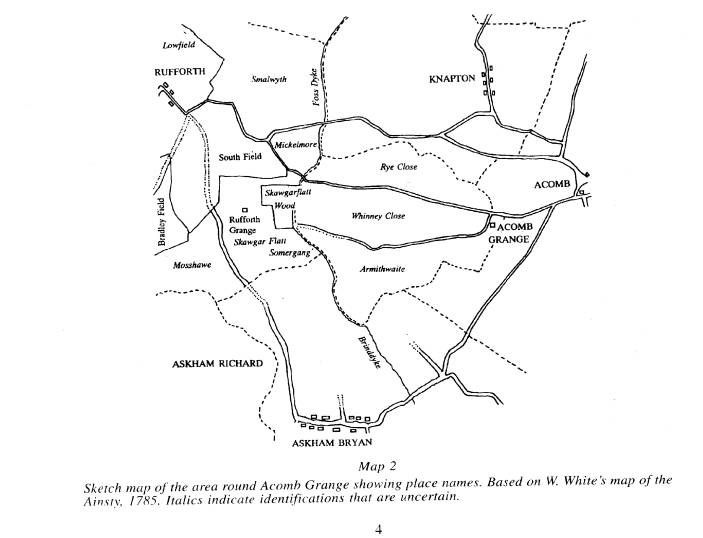
Figure 2
Based on W White's map of
the Ainsty of York , 1785
Article continues on next
page at the top of column 1
Clicking on the reference numbers
will show ref details
Return to start of article |Go top of this
page | about the author,Jennifer Kaner
| About the publishers | Home
page
Acomb Grange by Jennifer
Kaner - page 5
|
Walter de Langton was also Treasurer of England. The Lichfield
material is very detailed, providing lists of hospital servants, lists of
stock, including the cows which provided milk for the orphanage, and surveys
of various properties. Acomb Grange was valued in 1287 at 8s. The survey described the
manor site as surrounded by a ditch (fossaturn) and a hedge (hayarn). There
was another house called Godeshalles worth yearly 2s. There were 300 acres of
payable land by the small hundred, worth 8d an acre, and 23 acres of meadow,
worth 20d an acre. There were also two woods of which the pasture, husbote,
haybote, underwood and pannage were worth 60s. This is likely to have included the property in Rufforth mentioned
above.The total amounted to £15 l0s 4d. For comparison, the income in the
same valuation from Beningbrough was £19 5s 4d and from Heslington £20 7s 7d.
The collection of St Peter's corn (i.e. the thraves) made there from various
places was worth £5 4s 7 1/4d. Later evidence indicates that Petercorn collected
at Acomb came from Follyfoot, Healaugh, Wilstrop, Marston and Poppleton.15 14th Century accounts The 14th-century accounts16 show that one of the serviens of Acomb,
John de Hemingbrough, received a length of cloth for his clothes. Men of
higher status got lambskin trimmings as well. John got the same as the
hospital smith, the janitor and the cook. There is no sign of income from
Acomb in these accounts, except for £4 3s 4d for 5,000 faggots sold from
Acomb wood and 2s for pasture in the wood and grass on three selions next to
Mossawe. Hugh de Helmsley, serviens of Acomb, paid 24s l0d for rent in Rufforth
and received 65s 6 1/2d as a payment, along with Richard de Foxholes who
received £17 16s by tally. The reason for these payments is uncertain but
perhaps all the produce of the Grange went straight to the Hospital and the
payment provided the working capital for running the Grange. Walter de Langton - Treasurer of England After Edward I died, Edward II
arrested his father's Treasurer, Walter Langton, who had been Master of the
Hospital, and put him on trial. He invited complaints about his conduct from
anyone who had a grievance. |
|
Buried in a long list of complaints from all over England
are several relating to Acomb Grange. 17 Walter de
Langton seems to have spent some of his time at Acomb Grange, using it in the
same way as the Abbot of St Mary's used Overton and the Archbishop used
Cawood and Bishopthorpe. He was accused of misappropriating money and
property and of using his position to bully people. For example, his servants had ordered £20 to be spent on making a
ditch at Acomb Grange [in the reply it was 'the ditch of the said manor']
which they had extorted from one John Sampson who was in prison. More significantly a William, son of Alan of Knapton, complained that
while he was in the middle of sueing Master Alan Breton for a writ of right
in the court of his feudal overloard, Luttrell of Hutton Paynell, for some
property in Knapton, Walter de Langton bought the land. from Alan Breton by a fine levied
in the King's court. The court was adjourned and during the adjournment
various of Langton's servants went to the house of Robert le Turner,
William's attorney, in Knapton, seized him, bound both his hands and tied him
on a horse and took him to Acomb Grange where Walter de Langton was living.
From there he was forced to go to the court of Hutton Paynell and withdraw
the suit. William's son and John of Grantham also complained of being forced to
give up their rights in Knapton and of false imprisonment. John also
complained that he had 15 score sheep in Knapton common pasture and that they
had been taken to Acomb Grange, and when he had asked for his money he had
been imprisoned at St Leonard's. Walter de Langton’s defence in this case was that John owed money to the King for fines, which was the reason for his imprisonment, and that he had bought the sheep but had not paid for them. The rights and wrongs of each case are buried in time but the material illustrates the way a powerful man could use the law to his own advantage. |
|
|
|
|
Article continues on this
page at column 2 Article continues on next
page at column 1
Clicking on the reference numbers
will show ref details
Return to start of article | Go top
of this page| about the author,Jennifer Kaner | About
the publishers | Home page
Acomb Grange by Jennifer
Kaner - page 6
|
Langton soon got out of prison and back into favour with the King. He
certainly continued to hold a lease of Knapton but not the Mastership of St
Leonard's Hospital. His sojourn at Acomb Grange may explain the moat round
the site and the tooled stone which is to be found there. Also, if later
masters followed the same practice, it would explain why there was
expenditure on the Grange but so little income. Inquisition by the Crown An inquisition made by the crown in 1364 into the affairs of the Hospital18 indicated that income from almost all the holdings was much lower than in earlier years. The former value of Acomb Grange was £30 19s 7d. The deficit in 1364 was 72s 5d, but whether this was a short fall on the previous income or an actual loss is not made clear. However, the inquisition does show the Hospital's consumption of wheat, rye, barley and oaten malt, beef carcasses, pigs and mutton, stones of cheese and butter. |
|
In a later account John Day seems to sell the Hospital a cow which he pays for himself and on yet another occasion, when rendering up arrears, part was from the last account and part was for two cows. The significance of this is difficult to understand; it may be a matter of accounting. Certainly the serviens of Beningbrough and the hospital geldhird received cattle bought at Richmond by tally. Another beast was purchased from the Hospital by a woman of Rufforth, but this may be a payment to redeem a mortuary. So, after Walter de Langton's departure, for much of the 14th century, Acomb Grange was probably farmed directly by the Hospital and its keeper accounted by tally. In contrast, two men were employed directly as haiotors of the wood (see below). |
|
It also states how much in total came from the manors and how much was
bought. The accounts only show actual cash expenditure, so one finds money
spent on bringing cheese from Broomfleet and driving animals to York but not
the day to day expenditure at the 'manors'. The properties were supervised by
one of the brothers and a seneschal who travelled around taking courts and
seeing to harvesting and repairs; in 1343-44 they spent £13 14s 8d on their
travels, including journeys to Acomb, but also visited Holderness to buy
butter and Ripon to buy cattle! An interesting feature of the accounts from 1375-79 is a hint that the keeper of the Grange was being provided with cows by the Hospital which, in return, received payment for dairy produce. 19 The accounts are too badly damaged to be certain but '13s 4d rendered by John Day of Acomb for issue of 22 cows farmed by the said servant, for milk and calves per year 6s' may be interpreted in this way. |
|
Letting of closes By 1409 20 some of the
closes, including a pasture called Somergang, wre let out to York butchers
called William Tankerley, John Cundall and John Spynk. Pasturage was always
at a premium round York and the City council made strenuous efforts to
prevent the butchers driving up the price and monopolising all the nearby
pastures. Nevertheless York butchers appear as lessees of other pastures near
York, including the Tang Hall fields, the Vicars Leas and Heworth Grange. In the same accounts an ill horse caused great concern and medicines were bought for a foal suffering from the 'farcy'; a woman was paid to cut herbage in the garden of the Grange especially for it. Salve was bought for a little colt and halters were bought for two foals. |
Article continues on this
page at column 2 Article continues on next
page at column 1
Clicking on the reference numbers
will show ref details
Return to start of article | Go top
of this page|| about the author,Jennifer Kaner | About
the publishers | Home page
Acomb Grange by Jennifer
Kaner - page 7
|
Use of the estate as woodland Far more is recorded about the
wood than about the Grange. It was operated as a demesne woodland by the Hospital,
which also had a wood at Sutton Grange in the Forest of Galtres and rights to
timber and fuel from the forest; but Acomb wood was a significant provider of
timber, poles and faggots. The accounts show that the hedgers of Acomb wood were employees of the
Hospital in the same way as the smith, the tiler and the feriwoman. The
feriwoman was paid 2s a year, the miller l0s, the geldhird 14s and the
hayortor circum bosci de Akom 5s each. The hedgers were called Robert James
and Roger Day. William Wodhagg of the forest, a more important official, was
paid 13s 4d. The 1409 accounts also show that 64 men were paid 4d a day to cut underwood at
Acomb for pynnes for the bank of the Humber at Broomfleet, another St
Leonard's property. Seventy five cartloads of timber were taken from Mossawe
wood to the River Ouse, at a cost of 7d per journey, to build and repair
houses belonging to the Hospital in York. Thirty one men were also paid to
hedge round the pond. The three gates that they mended for the wood cost 7d.
The household and other workmen received 8d for food, at a time when 4d was a
day's wage. Rushes were cut for covering houses in the Hospital and the household
were paid for driving the animals and pigs in the wood. The Hospital also
moved animals from one Yorkshire property to another. Six score sheep came
from Lead to Acomb and the boys who drove them received 3d for drink. Others
went from Acomb to Broomfleet and from Broomfleet to Beningborough. Timber was cut in Mossawe and carted to the Ouse to be shipped to
Broomfleet.. It paid gatelay, a toll, at Middlethorpe. Timber was also
squared for the repair of houses in Beningbrough and sales of bark raised l0s
from John of Baildon. Two timber trees were bought by the Sheriff of
Yorkshire from Acomb wood to make 'engines' at York Castle in 1338-3921 The wood was mentioned frequently perhaps because cutting wood was
outside the normal work of the household at Acomb; most of the agricultural
products probably went straight into the hospital granaries and larders
without passing through the surviving accounts. For instance, in 1379-80 Roger Kidder and his servants were paid £6 12s ld for cutting and bundling 31,300 faggots in the woods. The following year 24,000 were cut, costing 4s 3d per 1,000. A John de Angrom was paid for 130 days at 4d a day for cutting and trimming fuel but other men working in summer got 5d a day. Perhaps wages rose during the hay harvest The wood sales continued with 200 faggots fetching 8s 4d and l0s coming from the sale of bark. |
|
In 1461~6222 more of the closes were rented
out, bringing incomes of £8 5s and £6 9s 8d. The wood continued to be run
directly with the 'receiver' travelling to Acomb to inspect the wood and
organise repairs. During this year timber from Acomb wood, along with
carpenters and carters, went to Heslington to frame a new barn. The men were
given beer while they worked at framing and erecting. Much effort went into shipping special long faggots from Acomb to
repair the staithe at Morhamwyk. Piles were bought at Carlton and 37 men were
paid for 'stuffing' the staithe and binding it with osiers and faggots.
Seventeen wagon loads of long faggots travelled from Acomb wood to
Bishopthorpe where they were loaded onto boats. Nineteen timber piles were
also felled and loaded. It was a major operation with servants from
Heslington getting faggots in Moreby wood for the same work, the Hospital having
taken a lease of Moreby wood for the purpose. Later in the year, when Acomb wood had presumably been more or less
stripped of usable timber and coppice poles, 5,000 faggots were cut for fuel
and 24 cartfuls were sold in York. Long faggots were also sent to Broomfleet
to repair the Humber bank. The method used can still be seen in action along
the Ouse and there may evidence for the practice in Viking York.23 Stakes are stuck vertically into the edge
of the river and bundles of brushwood are stacked behind. During winter
floods the bundles of twigs hold the mud and make a firm edge to the river. Six men were paid for repairing defects in the wood and one, John
Soule, who seems to have been in charge, was paid a fee for making hedges
round the wood. This would be standard practice after coppicing. The hedges
would be repaired to make sure that the animals could not get in to damage
the 'spring', i.e. the new growth. The Bryneng dyke was cleaned out by nine
men and 14 men were paid for cleaning out the moat round the 'manors'. Thirty four men were paid for dredging the ditch round Srnalwith. A
gate or door (porta) was made for Armathwaite and Towland and a bridge in Cow
Lane. Iron keys were bought for the gates of the manor and the doors of the
buttery. Planks were made for repairing the bridge at the gate of the manor
and an ash was felled for cart timber. So a picture is given of an actively managed woodland and a building that was being refurbished in 1461-62, but these are just brief glimpses which are difficult to interpret because of the way the accounts were organised. |
|
|
|
|
Article continues on this
page at column 2 Article continues on next
page at column 1
Clicking on the reference numbers
will show ref details
Return to start of article | Go top
of this page| about the author,Jennifer Kaner
| About the publishers | Home
page
Acomb Grange by Jennifer
Kaner - page 8
|
Just before the dissolution Just before the final Dissolution
of the Monasteries in 1539, which unfortunately included the Hospital, the
master and brethren let the Grange on a 30-year lease to Robert Metham and
Anne, his wife. The lease was for the Grange, the Coney Garth (l0s), Grenegarth (l0s),
the High Close bounding upon the Grene Garth (53s 4d), and a little close
called the Calfe close (13s 4d). 'They were not to strype or waste any maner
of wood pertaining to The Grange nor the hagg and were not to fell without
licence of the master except it be for the repair of house or hedges.' This is a fairly standard clause, but there was an additional, more
unusual clause that 'if the master and brethren during the thirty years are
minded to lye and kepe household in the mansion house of the same grange and
the buildings appertaining, upon a quarters warning Robert and Anne shal ly
clereley from the same during their time of residence there.' The total rent
was 43s 4d. The Methams also leased the tithes of corn and hay in Rufforth,
and more closes: the Wrangrow closes (53s 4d), the Whynne close (32s 8d). the
Yng close (13s 4d)- late of the holding of John Chilton gent- and the
Somergaine (66s 8d) . The total rent was £8 6s. They were to pay the parson of Rufforth 8 marks and keep 'the closes adjoining upon the woods competently fenced so that no cattail can enter for the destruction of the Spryng trees.' The master and brethren kept the right to cut open and occupy the close called Somergaine.24 |
|
Two years earlier Isobel Newarke of Acomb had leased a close called Mykelmore for 21 years, which lay next under Grainge
Smalwith. She was to repair the hedge using bandes and stakes delivered to her.25 It is likely that the Grange had been
leased out for some time. The will of John Chulton, dated 1520, describes him as 'of Acomb
Grange'. He left his best beast as a mortuary and 13s 4d to his parish
church; he also left 'a stotte and a wye' to St Leonard's Hospital, a horse
and best gown to his brother, a cow and whye to his mother and, to his
sister, 40s and a whye. His wife Anne and son were 'to occupy the farmholde
together as they do my goodes' and whichever of them should live the longer
was to retain the farm.26 His wife may have been a Snawsell, a family descended from a York
goldsmith who had settled in Bilton; John Snawsell, who was described by John
Chilton as his brother, witnessed and supervised his will. A Robert Metham,
son of a Sir Thomas Metham of Cave, had according to the Heralds' Visitation
married Anne Snawsell.27 If he was Anne's
second husband it would explain how the property came into the hands of the
Methams. Robert Metham first appeared at Acornb Grange in the 1524 subsidy roll. He is described as
gentleman and paid 26s 8d on goods valued at 40 marks. This was a high payment within the Ainsty,being exceeded only by Storey of Bikerton and Stapleton of Wighill. 28 Robert Metham acted as witness and supervisor of Seth Snawsell's will in 1537. 29 . |
|
|
|
|
Article continues on this
page at column 2 Article continues on next
page at column 1
Clicking on the reference numbers
will show ref details
Return to start of
article | Go top of this page| about the author,Jennifer
Kaner | About the publishers | Home
page
|
|
|
|
|
|
Acomb Grange by Jennifer Kaner - page 9
|
Robert
Metham was resident at Acomb at the time of the Pilgrimage of Grace and it is
interesting to speculate whether he was involved. His elder brother Thomas is
recorded as one of the leaders in the East Riding along with Robert Aske. His
father had been hauled from his bed by the pilgrims and nearly had his house
burnt. The Ainsty pilgrims certainly mustered near Acomb and at Bilbrough,
and several prominent local families, such as the Stapletons of Wighill and
Oswald Willstrope of Wilstrop, are mentioned in the records of the
Pilgrimage. The
assumption is that most esquires and gentlemen joined the pilgrims. When the
movement collapsed Sir Thomas Metham, Robert's father, was put on the jury to
try those considered ring leaders, and his sons, with most of the rest of the
gentry, conformed All that
can be said for certain is that in 1539, when a very full list of the militia was made in
the Ainsty, Robert Metham esq. is recorded in Rufforth and Acomb Grange as an
archer, horsed and harnessed, with a servant called William Wright. A William
Metham, probably his son, had a billman servant, horsed and harnessed, and an
archer servant with no horse or harness.30 In later
visitations Robert and his son William are recorded in Lockton, Lincolnshire
and a brass to William, son of Robert, second son of Sir Thomas Metham of
Cave, is at Rand in Lincolnshire. Robert's elder brother Thomas, who died in 1573, was
one of the first men recorded as 'a moste wilful obstinate papist' in the
aftermath of the Northern Rebellion of 1569. |
|
St Leonard's
Hospital was finally dissolved on 1 December 1539 and its
property went to the Crown. The
first Dissolution Accounts 31
show an income of 62s 4d from the vill of Rufforth, 106s 8d from the Rectory
of Rufforth and £22 8s from the Grange. The collector was Henry Burton. Robert
Metham was custodian of the wood of Acomb and received a fee of 2d a day and
six cart loads of wood under a lease dated 30 June 1525. Post Dissolution history. The accounts show that the wood was now being managed on behalf of
the King. There was a total income of £15 6s 2d from 1,100 faggots of
underwood and firewood and the tops of 35 trees were felled for timber for
repairs. Another 1,200 faggots had been sold from one of the haggs in Acomb
wood in addition to bundles of spines and briars. The
coppiced wood fetched 20s per 1,000 and the briars 8s 8d. The payment for
cutting was 5s a 1,000 for the first 10,000 and 4s for the next 12,000. Payment was also made for cutting 176 rods
of hedge and ditching round the wood at the rate of 2d a rod. Two bridges and three gates in Wode lane
were repaired and and the king's way in one venella was repaired for carrying
the faggots. The timber trees went to make a post,axletree and sparrs for the
Castle Mills in York and for Heslington windmill. |
|
|
|
|
Article continues on this
page at column 2 Article continues on next
page at column 1
Clicking on the reference numbers
will show ref details
Return to start of
article | Go top of this page| about the author,Jennifer
Kaner | About the publishers | Home
page
Acomb Grange by Jennifer Kaner - page 10
|
A little
later, in 1545/6, the receiver of all the money on behalf of the King,
Leonard Beckwith, was investigated by the Court of Augmentations for possible
fraud. A survey
of ex-monastic dernesne woodland was made32 which included, among
others, woods at Poppleton, Healaugh, Beningbrough and Acomb Grange. The wood
was described as having 106 acres divided into 14 coppices. These were 'sett
with underwood of the kynds of hazzel and sallow of sundrie ages and also
well sett with fair timber trees'. One
hundred and fourteen trees had been taken since the Dissolution, of which 58
had gone to a new barn in Poppleton and 58 towards the repair of the King's
mills, i.e. Castle Mills, and certain tenements in Heslington. Forty seven
had been felled by warrant of Leonard Beckwith, of which 37 had gone to
repair the King's tenements in York. The arithmetic is shaky and the evidence
was angled towards proving that Leonard Beckwith was exploiting his position,
but it gives a snapshot picture of the wood.By 1552/3 most of
the mature timber must have gone since George Gayle, the new tenant ,
received six timber trees from Poppleton wood to be carried to Acomb Grange.
It likely that these were for repairs by the incoming lessee. ( see below). 33 But, in 1556, when
George Gayle died, he left his wife Mary '3000 wood yerely forth of Acorn
Wood to be redy made carryed and layd at her dore'.34 There is also evidence
in the Acomb Manor Court Rolls of theft of wood from Acomb Grange by Acomb
tenants.35 |
|
In 1545 Acomb Grange had been leased for three lives to Ralph Bagnall, king's
servant, and Richard Mainwaring and Mary his wife, late wife of George
Cotton.36 George
Gayle, who had purchased a reversion of the lease in 1553, left it
to his son Francis. In 1557 Sir
Arthur Darcy purchased a licence from the crown to grant the reversion of the
lease to Francis Gayle and Anne his wife. This was all part of the
speculation in monastic property. Bagnall
and Mary Cotton had also received Foston and Kirby on the Hill and had as
rapidly sold them again. George
Gayle, the receiver of the trees, a goldsmith and Mas6ter of the Royal Mint ,
had also obtained a lease of Rufforth rectory and is recorded as a farmer ie
lessee of the manor of Acomb, in 1553, as well as the site of Wilberfoss Priory.37 George
was a wealthy man. He had been M.P. for York in 1533 and was
Alderman from 1529-56. The
Crown found his services as Master of the Mint so valuable that an
instruction came from London 'Understandying that ye mynd tellecte George
Gaill to the rome of Maryyaltie, the same beyng under tresouer of the mynt
shall not be able to supple bothe chargs. .. therefore we requyre that.... ye
will forbere telecte hym yeur Maier' .38 He was endeavouring to set up his son as a member of
the landed gentry. |
Article continues on this
page at column 2 Article continues on next
page at column 1
Clicking on the reference numbers
will show ref details
Return to start of
article | Go top of this page| about the author,Jennifer
Kaner | About the publishers | Home
page
Acomb Grange by Jennifer
Kaner - page 11
|
|
|
|
|
Francis Gavle and his descendants at Acomb Grange. Francis
Gayle, George's son was described as of Acomb Grange, although when he died,
a survey of his lands dated 1561/2,when his son Robert was five years old showed that
though he held Wilberfoss freehold, Acomb Grange was still held as a
reversion on the original lease to Ralph Bagnall.39 In his will,he
requested that he be buried at Rufforth 'nigh unto his children'.He left his
wife silver cups, a nest of bowls with a cover parcel gilt, 'a litle salt and
a chayne of gold'. Francis had his pedigree and arms recorded by the heralds
in 1563/4 40 The arms are described as ‘azure a fese between 3 sawtrells
argent on the fece 3 lionsheads erazed Azure. The crest to his armes on
a wrethe Argent and Azure an
Unycornehede paly of 6 Argent & Or ‘.In 1584 Robert, his son, was one of
the gentry whose arms were painted in the frieze of arms in the great chamber
at Gilling. 41.The family is not listed in the muster rolls
for the Ainsty. This is
a puzzling feature until one realises that as Robert was five years old when
his father died and, when Robert died in 1585/6, Francis, his heir, was aged
only four years eight months and 15 days, they were too young to have been
included in the muster rolls which survive; for example, in 1569 Robert would
have been 13 years old. Robert Gayle left this servant William Harrison a £5
a year annuity in 1585/6 and, in 1569. a William Herryson had provided armour
from Rufforth in the Ainsty rolls.42. John
Ingleby of the Ripley family is described as of Acomb Grange in 1573.He
appears in the Subsidy lists from the 1560s as having the wardship of Robert Gayle. 43. |
|
It is
interesting to note that despite its absence from the
muster rolls the Grange does appear on Saxton's map of Yorkshire of 1577. The
Inquest Post Mortem for Robert Gayle in 1585/6 records that he held the site
of Wilberfoss Priory, Nunpallions in Escrick, Rufforth rectory and Acomb
Grange. He held the last from the Crown by 'military service for a rent of
22s 6d. [This rent was still being paid as a fee farm rent to the Earl of
Bridgewater in the 19th century.] The
military service was a carryover of a feudal tenure that ensured that the
heir had to pay a fine to inherit and, if he was under age, the wardship
could be granted out by the Crown for a fee. The
Grange seems to have continued as a leasehold property into the reign of
James I. 44 . Like the Methams, the Gayle family were
Roman Catholic and intermarried with other Yorkshire Catholic families, such
as the Mallorys and Thwengs; but they are not as noticeable in recusant records
as some of their contemporaries. Perhaps
they were more successful at dodging the law by moving from property to
property. However, in an undated Elizabethan list of priests and Catholics,
'Mr Gayle of Acame Grangre nere Yorke doth lye sumtymes at Carlton. He hath
been eight yeres maryed and yet never came at the church. He was marryed at
the masse. He hath vi children who were all christened by the old lawe '. 45 |
Article continues on this
page at column 2 Article continues on next
page at column 1
Clicking on the reference numbers
will show ref details
Return to start of
article | Go top of this page| about the author,Jennifer
Kaner | About the publishers | Home
page
Acomb Grange by Jennifer
Kaner - page 12
|
In 1581 Tristram
Tyldesley, priest at Rufforth and vicar of Acomb, had been in considerable
trouble for dancing at a rush bearing at Rufforth church, where he 'very
unseemely did dance skip leap and hoighe gallantly'. In the
evidence Tristram describes dancing at Mr Gayle's house 'in the times of
Christenmas and harvest.. emongst other honest yonge company'. He was
suspected of being a papist or 'mislyker' of the established religion. 46. From 1611 onwards the Gayles were certainly
presented for recusancy in a number of Ainsty parishes including Rufforth and
Acomb. They also appear in Nether
Poppleton, Bilton and Marston.In 1603/4
Barbara Gayle appears in Marston; Barbara , wife of Francis Gayle of
Acomb Grange,appears in 1611 and Francis Gayle Esqin 1633/37. Catholics were
presented for not attending church or not going to communion or for being
recusant. 47. The
Gayles (or Gales) were in the last category so almost certainly would have
had their estates sequestered and would have had to pay two thirds of the rents
to the Crown. They compounded for their estates in 1629 when they agreed to
pay an annual rent charge of £20 on all their estates in return for not being
molested.48 Life was extremely hard for Catholics; they
found it difficult to resort to law, paid extra taxes, were fined for not
going to church and the gentry had to provide a light horseman for the
militia as well as only keeping a rent charge from their estates. Not
surprisingly they found it difficult to make ends meet and were often heavily
in debt. Richard Cholmondley's Household Book49
provides a fascinating picture of the problems of a Catholic family of this
period at Brandsby. Much depended on how zealous the local
authority was. In this case the authority was York, who seem to have allowed
more Catholics to slip through the regulations than in other areas. |
|
Despite
their problems, the Gales persisted in their Catholicism. Matthew
Gale, son of Francis and Barbara Gale, is recorded as a student at Douai
College in 1629. He had been there earlier but had returned home for four
years. He was
in trouble for not keeping up with his work and refusing to provide a
'discourse for the Ascension’. He was supposed to do a penance in the
refectory, i.e., he was to spend an entire lunch time kneeling and also write
an essay. He disappeared from the college at that point but returned later,
did his penance, completed his studies and returned home having matriculated
in logic.50 He was
recorded in Heworth in 1640 and was regularly presented as a recusant in
Rufforth from 1657. He married Ann Thweng, a member of another staunch
Catholic family. A Robert
Gale, probably Francis' elder son, was recorded as a 'papist in Arms' in
1648. Under the pressure of debt the Gales had mortgaged part of Acomb Grange
in 1607-8 and sold their property in Wilberfoss and Escrick and the advowson
of Rufforth. They had
also settled their properties on trustees on the occasion of Robert’s
marriage to Elisabeth Langdale in 1624.In addition they sold a property in
Acomb to one Peter Hill and it may be noted that one of the fields is later
called Peter Hill wood. This is
probably the same Peter Hill of Acomb whose name is remembered in Clifton as
the source of a local annual charity dole and who has a road named after him.
Robert
Gale fought in the civil war but was unable to pay his fees for compounding
and all the family property in Rufforth, including Acomb Grange, was sold by
the Treason Committee of the Commonwealth in 1652 to Thomas Raper and Joseph
Micklethwaite of York for £4,002 2s 2d. 51 At the time there were
seven Rufforth tenants holding messuages, arable strips, meadow and parts of
Smalwith. One was Matthew Gale. |
Article continues on this
page at column 2 Article continues on next
page at column 1
Clicking on the reference numbers
will show ref details
Return to start of
article | Go top of this page| about the author,Jennifer
Kaner | About the publishers | Home
page
Acomb Grange by Jennifer
Kaner - page 13
|
The purchasers
passed the Grange and the closes listed with it, except the Somergames and
Mossie Spring, to a London merchant, called John Lawrence, for £1,200. In
1659 John Lawrence sold his interest to Thomas Creswick, a Sheffield cutler,
who immediately transferred it to Edward Gaile, clock-maker of York.52 By this
time both the Somergames closes and Mossy Spring and a group of closes north
of the old Wetherby road were excepted. Edward Gaile then leased it back to
Robert Gale for 99 years at £78 per year. The
story is difficult to untangle as some of the transfers may be mortgages;
certainly Robert Gale seems to have borrowed £5,200 from Edward Gaile. The
attempt to keep the property in the family failed and in 1663/4 the estate
was sold to the Marwood family of Little Busby for £3,800. |
|
The
Gales procrastinated over moving out and a legal agreement had to be made
that they would vacate the Grange by Lady Day in 1666. They were recorded in the Hearth Tax in
1665 with one house of five hearths and one of four. They
seem to have continued to live in Rufforth, possibly in the village in one of
the other properties acquired as part of the St Leonard's lands, as they
still appear with four hearths in 1670. 53. They continue in the lists
of recusants for Rufforth until 1682, long after Acomb Grange had passed into
other hands. A later
copy of the Parliamentary survey originally made for the Treason Committee
gives all the field and wood names.54 The field names include
Mossy Spring pasture, Micklemore close and Micklemore, Over and Nether
Spring, and Skawger flatt. Great Somergames and Lee Somergames, Armithwaite
and Smawith are other names that remain from the medieval St Leonard's
records. |
|
|
|
|
Article continues on this page at column 2 Article continues on next
page at column 1
Clicking on the reference numbers
will show ref details
Return to start of
article | Go top of this page| about the author,Jennifer
Kaner | About the publishers | Home
page
Acomb Grange by Jennifer
Kaner - page 14
Map of the Acomb Grange property owned by
the Marwood family 1760.
Reproduced by permission of NYCRO (ZDU 82
mic 1294 fr 2079)
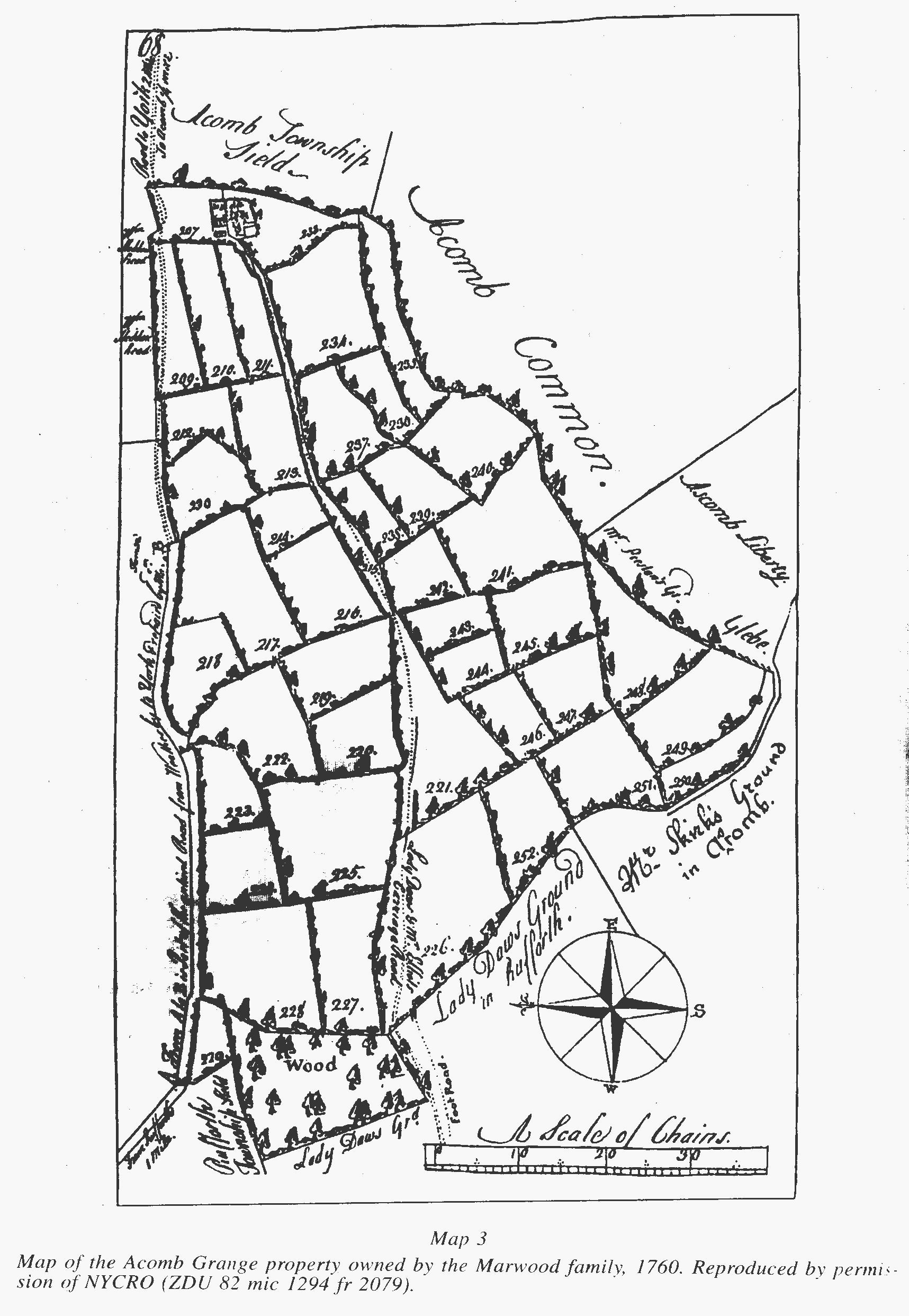
Figure 3 Article continues on next
page at column 1
Clicking on the reference numbers
will show ref details
Return to start of
article | Go top of this page| about the author,Jennifer
Kaner | About the publishers | Home
page
Acomb Grange by Jennifer
Kaner - page 15
|
The estate under the Marwoods Henry Marwood
of Little Busby bought the Acomb Grange site and the land lying to the south
of what is described as 'the old road to Wetherby now a bridleway' (Figure
3). The 1671
Hearth Tax for Rufforth records a house of seven hearths.55
The land to the north of the road had been sold to Nicholas Blackbeard or
Robert Swan, and Mossy Spring, Scawgerwood flat, Great Somergang and
Somergang leaz were sold to Christopher Adams in 1652/3. Christopher
Adams' purchase probably represents the land originally granted by Geoffrey
and his family in Rufforth, except the tofts and open field land and the area
called Smalwith. In the deeds for sale all the properties may well have been
described as Acomb Grange als Rufforth Grange. Ultimately
both the other blocks of land acquired farm houses and both were called
Rufforth Grange. Indeed, in the 1851 census all three properties are called
Rufforth Grange. An 18th-century map of the Acomb Grange property exists and
it is possible to deduce that Mossy Spring and Scawgerwood flatt were the St
Leonard's properties in Rufforth, the Moschawe of the 1231 grant, and then
became the Rufforth Grange on the airfield. It later
passed into the hands of the Lascelles family. They made very good maps of
their estates and these enable one to identify Mossy Spring or Moshawe with a
group of fields to the west of Mossy Lane, which used to lead from Rufforth
to Askham Bryan. It is now cut by the airfield. This may
have been the route taken by the medieval carts to the River Ouse at
Middlethorpe. The other field names recorded in the Harewood estate papers
are less informative.56 Rape close, Cow pasture,
Muckhill and Pighill lay between Rufforth Grange and the Askham Bryan
boundary. These may be the former Somergames closes.
The funnel shape of the field boundaries leading from the broad lane towards
the Rufforth boundary may be the relic of an ‘outgang’ to summer pasture possibly originally
shared among a number of townships. |
|
The
Scawegar wood flatt, possibly the scalerkerflath, was sold with the
Somergames closes and may well represent the land on the
airfield to the north of Rufforth Grange. The names in 1760, North Close and
Winter Close are again unhelpful. In 1664,
24 acres of Shawgar flatt wood and 25 acres of Laithe wood were in Marwood's
ownership and therefore probably represent the woodland over the Foss, which
is marked on the 18th-century maps and the first edition O.S. map adjoining
the Winter close and North close. Some of
it still remains on the edge of the airfield. It does support some woodland
species, such as bluebell and wood anemone, but is chiefly remarkable for the
remains of shelters and dispersal bays from the Second World War. The
original Acomb wood is represented only in field names - Outlaw wood, Pullen wood close, Buttery wood
close, Thyman or Butcher wood close and, in 1664, Peter Hill wood and Horse
wood. By 1760 Horse wood was still a field name, as is Paterkill wood! Now
the only reminder of the original wood is the name Woodhouse farm. The
woods, as in the time of St Leonard's, were not let out with the farm but
were kept in demesne by the Marwoods. In 1707 there are payments for clearing
rubbish underwood at Acomb Grange and, in 1778, the wood may have been clear
felled, as there were sales of ash trees, 33 loads of firewood and 1,200
stakes. Mr
Priestman, the York tanner, bought 25 quarters and seven bushells of bark
and, though 200 handbills were printed to advertise the wood, no cash is
recorded from oaks sold. It is interesting to note how similar the expenses
are to those incurred 200 years earlier. Once
again ditches were dug out, 6 ft wide and 3 ft deep, and the hedges by the
beck and against Rufforth were cut and laid. They were described as 31 acres
in length! The ditch on the west side of the wood was 4 ft deep 2.5 ft wide
and 11 acres 3 roods in area. In 1809
Mr Dodsworth, the York timber merchant, bought timber and Mr Priestman, the
Marygate tanner, once again purchased the bark. In 1866 sales on ash trees
raised £48 17s 4d. oaks, £188 4s 3d and bark, £114. There were 19 tons of it
in all. |
|
|
|
|
Article continues on this
page at column 2 Article continues on next page
at column 1
Clicking on the reference numbers
will show ref details
Return to start of
article | Go top of this page| about the author,Jennifer
Kaner | About the publishers | Home
page
Acomb Grange by Jennifer
Kaner - page 16
John Etty’s plan for a house at Acomb Grange
, 1694
Reproduced by permission of NYCRO ( ZDU mic
1294 fr 2255 )
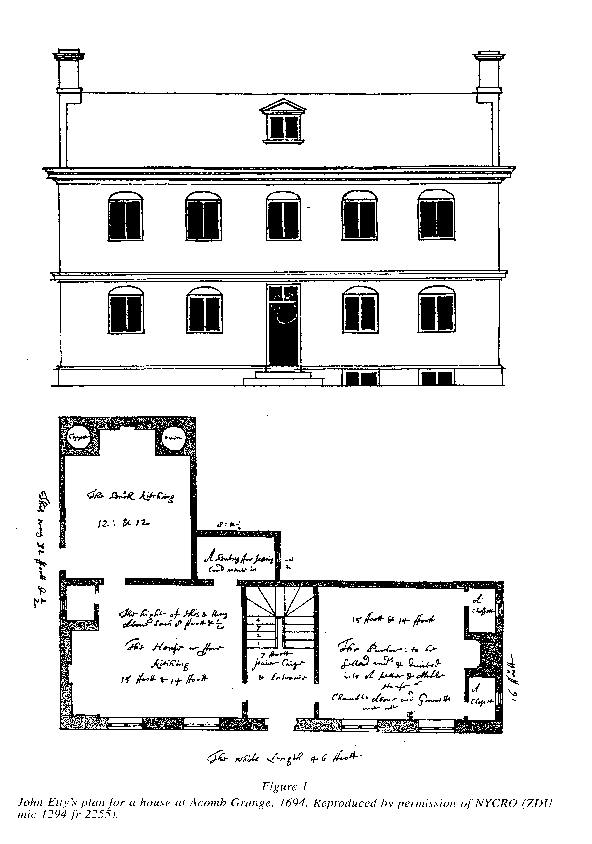
Figure 4
Article continues on next
page at column 1
Clicking on the reference numbers
will show ref details
Return to start of
article | Go top of this page| about the author,Jennifer
Kaner | About the publishers | Home
page
Acomb Grange by Jennifer
Kaner - page 17
|
The
history of the house is a puzzle. All that is known of the earlier building
is that in the parliamentary survey of c.1650 there was a manor house, the
ancient seat of good family, old fish ponds, a good dove cote and a very
brave barn. Three
orchards of good fruit trees produced a tun or two of cider every year. Henry
Marwood is recorded as paying tax on seven hearths in l670. 57.
suggesting that it was a reasonably substantial house which could have been
used by him when he visited York. His
father George, in 1669, wrote 'For this at Acame you must resolve to build
there if you will see your own money from it. In the meane time I ordered
Soulby to find out a tenant for the low house' .58 Today
two houses adjoin each other, one single piled, the other a substantial
double-piled building. The puzzle is how long has this pattern existed? In 1694
John Etty, the York architect, provided a design for a new farm house (Figure
4). 'The olde buildings now standing are soe meane and measurably out of
repair that their can nothing be don to them it will be money thrown away and
the dwelling house soe ill contrived thatt their is no conveniency.' John
Etty had been City husband in charge of York Corporation property and had
designed St John's church in Leeds and rebuilt the west wing of Temple
Newsam. His epitaph was 'By the strength of his own
genius and application had acquired great knowledge of Mathematicks,
especially geometry and Architecture in all its parts far beyond any of his
contempories in this city. . . . ' 59 |
|
From
evidence in Etty's letter there were two buildings which
were built of brick and tile and which had some timbers worth saving. The agent pointed out that there were but three
rooms to a floor and that it might be better to have four so that it might
suit a gentleman or tenant. The
problem is whether Etty's house was built and, if so, was it the smaller
surviving house or on the site of the larger one? The current situation of
two adjoining houses appears to date back to at least the 18th century. In 1760
two brothers divided the farm between them and there is mention of the low
house. The contemporary map shows one house but is illustrative rather than
accurate. A sale plan of 1810 60 shows that the larger house
was there by then. There is
a strong possibility that the smaller brick-built house may be Etty's
farmhouse. The detailing over the windows, now seen as shadows in the
brickwork, and the mark where there was a string course can just be made out
and stones have been reused in the side wall. It is of
course possible that the larger house was rebuilt with Etty's detailing and
the smaller built to match, with the farmer and the gentry tenant living side
by side. In 1725
when Lord Harley, the future Earl of Oxford, visited York he described
Bishopthorpe, the home of the Archbishop, and Middlethorpe Hall as lying on
one side of his road, and Askham Moor, a marshy bottom, and 'Askham Grange
Sir Harry Marwoods' on the other; by then, therefore, it was large enough to
be a landmark,61 yet throughout the 18th and 19th
centuries all the tenants were farmers. |
Article continues on this
page at column 2 Article continues on next
page at column 1
Clicking on the reference numbers
will show ref details
Return to start of
article | Go top of this page| about the author,Jennifer
Kaner | About the publishers | Home
page
Acomb Grange by Jennifer
Kaner - page 18
|
The problem
can only be solved by an internal examination of both houses. There were
extensive repairs in 1809-13 which may well have been almost a rebuild.62
They
include 29 yds of floor boards, flags for a passage floor, a hearth and back
hearth in a low room, and the hanging of 12 doors. Another bill includes '57
ft of architraving, roofing and joisting the dwelling house and ceiling
joists in kitchen and house, sash windows and window shutters and the
building of stairs, 4 yds 6 ft at 9s a yard'. This seems more than an
ordinary repair job, possibly a large-scale extension. The farm
was a mixed farm. When Marwood took over from the Gales the agreement
included payments for acquiring 19 loads of maselin, harrowing and gripping
and laying compost and manure on the fallow and sowing the maselin. Twenty
one quarters of oats were sown in the old hard corn field, a process which
included 44 'plowings', presumably days of ploughing. At first most of the
closes were let out to different men and only a few were kept in hand. In
1685, Henry Marwood let the Grange to Henry Boswell and the tenancy agreement
restricted the ploughing to no more than 40 acres and the cutting of wood to
that set out by the landlord. If
Marwood had not moved his stock by a certain date, the tenant could go on
pasturing his stock for the same amount of time after the end of the lease.
The apple trees mentioned in the Parliamentary survey were still producing
fruit in 1683: the agent at Busby, the main estate, was very worried because
the wet weather had made the ways so bad that no one would go to fetch the
apples.63 A survey
of 1760 has the farm divided between William and David Ward. It shows that
wheat, oats, barley and beans were being grown, but there was more pasture
than arable. |
|
William
Ward's farm grew wheat, beans and flax and various comments were made on
fields being badly laid to grass with furze and thistles, pasture spoiled by
bad management and the flax crop spoiled by thistles. His successor,
John Ward, was criticised, though not as fiercely, in 1783 when he gave up
his tenancy. He was allowed to reap his crop and take away the helms and was
allowed £63 for repairs. In 1810,
when the Marwoods put the farm up for sale, the tenant was John Jolly. By
this time some of the closes had been divided and several had changed their
names. Only 42 acres, a block in the centre of the farm, were actually sold;
the remainder stayed in the hands of the Marwood family with a Jolly as
tenant until at least 1865. The fee
farm rent was still being paid in 1903 and in 1911 the Great Ouseburn
District Council paid the Marwoods a rent for a rubbish tip. This,
incidentally, was very unusual at that time. In the district council area
only Boroughbridge had had a scavenger and a rubbish tip by this date. Places
like Heworth had to wait until the l930s. This tip was for Acomb rubbish and
was a dip in a field, possibly an old sand pit. The district council paid to
fence it.64 The rent
received for the Grange, £453 in 1903, made it one of the Marwoods more
productive properties. At this
point there was a change of tenancy and the farm valuation included
raspberries and gooseberries, a turnip house, a barn, threshing machine and a
chain pump, as well as a blacksmith's shop, gates, mangers, etc. The
blinds and rollers in the house and the table and shelves in the dairy were
allowed for, as well as a house called a Hind house. It was described as a
dairy farm in 1909, when the well water was tested. |
Article continues on this
page at column 2 Article continues on next
page at column 1
Clicking on the reference numbers
will show ref details
Return to start of
article | Go top of this page| about the author,Jennifer
Kaner | About the publishers | Home
page
Acomb Grange by Jennifer
Kaner - page 19
|
The
Marwoods were absentee landlords leaving most of their affairs in the hands
of a Durham firm who did the annual accounts, the occasional surveys and
ventured south to deal with valuing land and estimating injury by severance
when a proposal to build the York Leeds railway was made in 1845/6. As this
would have crossed the entire length of the property on a line south of the
wood and of the main farmhouse, it would have been devastating to the farm.
The plan was to end the line in Micklegate, on the line of what is now Priory
Street, so it would have had equally devastating effects on York;65
but it was never built. The
problems of injury by severance occurred again in a heightened form in the
l980s when the York ring road was built across the farm but without the
bridges and underpasses that the railway would have had to provide for
farmers. The
estates were entailed but by 1922 were running at a loss and more and more
land was being sold. Rents for Acomb are not mentioned after 1923. The
modern farm suffers from being split by the ring road and from damage done to
crops in fields adjoining the housing estates. Etty's farmhouse is not in use
at present, though the main house has recently been reroofed. A timber
and brick barn on the site, presumably the 'brave barn' of the parliamentary
survey, was examined in 1972 by the Royal Commission on the Historical
Monuments of England and tentatively dated to the 17th century. Earthworks
survive surrounding the site while pieces of tooled stone lie in hedge
bottoms. The ponds, so carefully cleaned out by the Hospital servants, have
now gone, but are on the 1852, 1893 and 1975 0.S. maps. |
|
Many of
the old hedges have also disappeared but the original boundary between Acomb
and the Grange shows up more clearly than ever, as it now
forms the boundary of the City of York and of the Chapelfields council
estate. The
boundary between the Long Ing (Meadow) and a close called Clappers in 1760,
which still has traces of ridge and furrow,67
and a pond from the Little Pond Close of 1760 still shows up in a 1989
photograph but is not marked on the OS map. The
pattern of fields on an aerial photograph of 1967 68 is still much the same
as that shown in 1760, but has now (1991( almost gone. Even the old wood
lane, which was called Lady Dawes carriageway in 1760 and Broad Lane in 1852,
has been almost obliterated. The
‘ancient road from Wetherby to York’ which forms the northern boundary of the
existing Acomb Grange property is a bridleway and tractor track. It has
clearly defined hedges and a few bluebells as a reminder of its earlier
pre-turnpike role through a wooded area. It used
to join the ‘New Gate’,the current Wetherby Road;but this piece of landscape
history was obliterated by the Second World War Rufforth airfield.It is
remarkable that any part of the woodland survives, although it is only a
small part of the 106 acres that it used to cover. For the
future, with the threat of development on the outskirts of York,it is important
that this Grange site is properly protected and recorded. It is hoped that
the finding of an Etty architectural plan and the knowledge that the Grange
spent a few years as the residence of Walter de Langton might alert people to
its existence and possible significance. |
Article continues on this
page at column 2 References
and acknowledgments continues on next
page
Clicking on the reference numbers will
show ref details
Return to start of
article | Go top of this page| about the author,Jennifer
Kaner | About the publishers | Home
page
Acomb Grange by Jennifer Kaner - page 20
The author
acknowledges the help received from the Record Offices of North Yorkshire,
Leeds, York, York Minster and the Borthwick Institute of Historical Research.
Permission was given to take exterior photographs of the house by the present
occupants of Acomb Grange.
NOTES
- W.
Farrar, Early Yorkshire Charters Vol. I [EYC II, 143 Return to main text (1).
- P
H Cullum, Hospitals in Medieval Yorkshire D.Phil. thesis, University Qf
York (1989). Return to main text (2).
- EYCJ,
141. Return
to main text (3)
- Lichfield
Record Office, QQ 1-10. Return to main text (4)
- York
Minster Library [YMLJ, M2/6b-d. Return to main text (5)
- W. P.
Baildon (ed.), Monastic Notes Vol. I, Yorkshire Archaeol. Soc. Rec. Ser.
Vol. xvii (1895), 247. Return to main text (6)
- A.
Beardwood, Records of the Trial of Walter Langeton, Camden Society 4th
Ser. Vol. 6 (1969), 307. Return to main text (7)
- J. Parker (ed.), Yorkshire Fines,
Yorkshire Archaeol. Rec. Ser. Vol. 62 (1921), 28, 132. Return to main text (8)
- Bodleian,
Rawlinson B455. Return to main text (9)
- J.
Sheppard, Ceo graJiska Annaler Vol. 48 (1966). Return to main text (10)
- North
Yorkshire County Record Office [NYCRO], ZDU 13 microfilm [mic.] 1350. Return to main text (11)
- EYC I, 356-7. Return to main text (12)
- NYCRO,
QDP (M) 60. Return to main text (13)
- C. T. Flower (ed.), Public Works in
Medieval Law Vol. II, Selden Society 40 (1923), 320. Return to main text (14)
- A thrave was a stook of corn from every plough.
This usually came to 12 sheaves but varied according to the traditional
size of the stook. It may originally have been a thrave from each carucate
. . . a royal food tax. Return to main text (15)
- YML, M2/6c. Return to main text (16)
- N.B. There is a possibility
that these records refer to Acomb itself. Although nothing so far
discovered links Walter of Langton with the Treasureship of York Minster,
a detailed survey of Acomb and other lands belonging to the Treasurer has
been found in the Lichfield archives ~RR3]. The Treasurer of the time was
an absentee Italian! The property referred to in the evidence is sometimes
called the Grange of Acomb and sometimes Acomb. Return to
main text (17)
- Calendar
of Miscellaneous Inquisitions Vol. III, 202-4. Return to main text (18)
- Cf.
D. Michelmore (ed.), Fountains Abbey Lease Book, Yorkshire Archaeol. Soc.
Rec. Ser. Vol. 140 (1981), l-lvii. Return to main text (19)
- YML, M2/6b. Return to main text (20)
- Public
Record Office [PRO], El01 597 24. Return to main text (21).
- YML, M2/6d. Return to main text (22)
- R.
Finlayson, 'Oh! What a Lovely Waterfront', Interim Vol. 12 no. 3 (York
Archaeol. Trust 1987), 7. Return to main text (23)
- PRO, E303 26 1206, 1207. Return to main text (24)
- PRO, E303, 26 1211. Return to main text (25)
- YML, St Leonard's Wills M2/6e. Return to main
text (26)
- Metham of Bullington, Lincolnshire Pedigrees, Harleian Society Vol.
51(1903), 669. Return to main text (27)
- E.
Peacock, 'Roll of York and the Ainsty Subsidy, 1524', Yorkshire Archaeol.
J. 4 (1877), 198. I am grateful to Marjorie Harrison for this reference. Return to main text (28)
- Testamenta Eboracensia Vol. 6, Surtees Society Vol. 106 (1902), 62.
Return to main text (29)
30.PRO, E361/32. Return
to main text (30)
- PRO,
SC6 Henry VIII 4601. Return to main text (31)
- PRO, E315 429. Return
to main text (32)
- Leeds City Archives, GC L02. Return to main text (33)
- Borthwick
Institute of Historical Research, Wills Vol. iSA, f.62. I am grateful to
Vivien Swan for pointing out this reference. Return to main
text (34)
- H. Richardson (ed), Court Rolls of
the Manor of Acomb Vol. I, Yorkshire Archaeol. Soc. Rec. Ser. Vol. 131
(1969), 4. Return to main text (35)
- Letters
and Papers of Henry VIII Vol. xxi, 777. Return to main text
(36)
- Op.cit. in note 35. Return
to main text (37)
- D.
M. Palliser, Tudor York (1979), 92. Return to main text
(38)
- PRO,
SP12 21 f.2. Return to main text (39)
- C. B. Norcliffe (ed.), Flowers
Visitation of Yorkshire Harleian Society Vol 16 (1881), 131-2. Return to main text (40)
- J. Foster (ed), Visitation of Yorkshire,
644. Return to main text (41)
- York City Archives [YCA], E47. Return to main text (42)
- Ibid. Return to main text
(43)
- NYCRO, ZDU mic. 1325. Return
to main text (44)
- Catholic
Record Society 53, 191. Return to main text (45)
- Yorkshire Archaeol. .J. 15, 242-3; 1. 5.
Purvis, Tudor Parish Documents of the Diocese of York (1948), 167-8. Return to main text (46)
- H. Aveling, 'The Catholic Recusants
of the West Riding of Yorkshire', Leeds Philosophical and Literary Society
10 (1963). Return to main text (47)
- Op.cit. in note 45, 318. Return to main text (48)
- Publisher NYCRO. Return
to main text (49)
- E. H. Burton and T. L. Williams (eds.),
'The Douai College Diaries', Catholic Record Society 10. Return
to main text (50)
- NYCRO, ZDU 14(13) mic. 1352. Return to main text (51)
- Ibid.
Return to main text (52)
- YCA,
M30: 22, E8OA. Return to main text (53)
- NYCRO,
ZDU mic. 1294, appendix. Return to main text (54)
- YCA,
M30: 25. Return to main text (55)
- Leeds
City Archives, HAR Surveys 64 Vol. 3 Return to main text
(56)
- YCA, E8OA. Return to
main text (57)
- NYCRO,
mic. 1298 fr. 0240. Return to main text (58)
- G.
Beard, Craftsmen and Interior Decoration in England, 1660-1820 (1981),
259. Return to main text (59)
- NYCRO,
ZDU 14 mic. 1325. Return to main text (60)
- Historical
Manuscripts Commission, Report on the Manuscripts of the Duke of Portland
Vol. 6 (1901), 93. Return to main text (61)
- NYCRO, ZDU 14 mic. 1295 fr.
3129, mtc.. 1294 fr. 2302. Return to main text (62)
- NYCRO,
ZDU mic. 1294 fr. 2298. Return to main text (63)
- NYCRO, Great Ouseburn District Council
Minutes, Sept. 1910, mic. 1965. Return to main text (64)
- NYCRO, QDP(M) 60. Return
to main text (65)
- Photographs and plans can be seen at the
York office of the Royal Commission on the Historical Monuments of
England. Return to main text (66)
- Aerial
photograph by Anthony Crayshaw, 1989. Return to main text
(67)
- Archaeology
Department, North Yorkshire County
Planning Department Return to main text (68)
The publishers of the article by Jennifer Kaner
Return to article on Acomb Grange
The article ‘Acomb
Grange’ by Jennifer Kaner was the winner of the 1991 Sheldon Memorial
Trust Essay Competition.
It was
published in ‘ York Historian’, volume 10, 1992 a publication of the Yorkshire
Architectural and York Archaeological Society (YAYAS), which is a registered
charity and was founded in 1842. YAYAS
have kindly given permission for this article to be reproduced on the internet.
The copyright vests in YAYAS, and any use of the
information in the article must be authorised by YAYAS.
York Historian is a regular publication covering many
aspects of the history of York. Back numbers and details of subjects covered in
previous issues can be obtained by emailing a request to enquiries@yorktour.co.uk. Your
enquiry will be passed to the publishers for them to deal with.
Return to
article on Acomb Grange
About the author , Jennifer Kaner
Reproduced with kind permission from the Yorkshire Evening Press of
September 28th 2000 Return to article on Acomb
Grange
TRIBUTES have been paid to Jennifer Kaner,
"York’s foremost local historian", who has died aged 64 following a
long and brave fight against cancer.
A memorial service for Mrs Kaner, whose husband,
Ralph, is a former managing director and chairman of Rowntree’s Confectionery
Division, will be held at the Friends’ Meeting House in Friargate, York, at 2pm
tomorrow.
Born in Kenya, she was educated in Somerset and at
London University, working for Clarks Shoes in Street, Somerset, before
becoming a personnel officer at Rowntrees in York.
Mrs Kaner was a major figure in local history circles,
starting classes for the Workers’ Educational Association (WEA) where students
researched their own areas.
The first was at Burnholme School focusing on Heworth
and Tang Hall. Clifton, Helperby, Fulford and Skelton followed. At South Cave
her group later produced their own publication with her help. She was a past
chairman of the WEA York branch and a member for over 20 years.
Current chairman Mrs Terry Fowler called her
contribution to local history "immense", adding: "She was very
popular and very helpful to people."
York city archivist Rita Freedman said: "York has
lost its foremost local historian. Jennifer Kaner has been responsible in a
large part for the great strides forward in local history taken over the last
20 years."
She had given tremendous support to the city archives
and its researchers for the last 23 years.
Dennis Brewster, treasurer of the Yorkshire
Architectural and York Archaeological Society (YAYAS), said Mrs Kaner had been
its lectures secretary until forced to retire a year ago.
She kept lecturing and researching until recently
despite being in considerable pain. He said: "I thought she was an
extremely clever and also very humane and very unselfish person."
Dr Ron Butler, former president of the Yorkshire
Archaeological Society and former editor of the Yorkshire Archaeological
Journal, said Mrs Kaner represented YAYAS on the Yorkshire body.
"She was energetic and persistent in her
research, and helpful to other people with information that she had found. She
was generous to other scholars," Dr Butler added.
Research by Mrs Kaner on local volunteering was used
in the formation of York’s Council for Voluntary Service (CVS).
Its general secretary, Colin Stroud, said: "She
played a key role in the development of the CVS itself and the volunteer
centre."
In addition to her husband, Mrs Kaner leaves three
sons, David, Tim and Ben, and four grandchildren.
Return to article on Acomb Grange
Last modified 04/12/2002